| Similar Seen in Other Hudson River Coves |
The Village closed Horan’s Landing because of a confirmed Harmful Algal Bloom (HAB) at Horan’s Landing June 12-14. This particular bloom is gone, but people have anecdotally reported these highly unusual blooms in coves along the Hudson this year, according to Sleepy Hollow resident and Riverkeeper president Tracy Brown. A HAB contains microcystis, a cyanobacteria that produces toxins harmful to people, pets and wildlife. It’s the bacteria, not the blue-green algae itself, that can cause rashes and damage to the nervous system or liver. Exposed dogs have died. Some HABs deplete oxygen and cause mass fish die-offs. HABs need warm, still water with extra nutrients from fertilizers or sewage. Usually they occur in late summer (when water is warmer) in ponds and lakes. Climate change encourages these blooms.”I was shocked to see it. Algae blooms are usually for August or September,” Brown said. “This is bad news.” The discovery of the bloom was just by chance, although Riverkeeper tests monthly for Phycocyanin, a component of dangerous algae. In May readings were high for all points between Poughkeepsie and Manhattan but one. This year’s algae, Brown said, is likely a consequence of the massive, unprecedented algae bloom last year near Kingston. We wouldn’t have known about the bloom if Brown hadn’t been walking by Horan’s Landing and spotted what she suspected was blue-green algae. She grabbed a sample herself and rushed it to Riverkeeper’s lab. She also walked the rest of the Sleepy Hollow shore to see if other areas were infected, but didn’t find any. Once Riverkeeper’s lab confirmed the cyanobacteria, Brown alerted Mayor Marjorie Hsu and Tara Scheller, who runs paddleboard lessons and excursions from Horan’s Landing.Brown said she was impressed with how seriously the village took the issue, closing off the dangerous water within an hour. “They were so responsive,” she said. Horan’s Landing is uniquely vulnerable because it’s a cove, sheltered from the Hudson’s strong currents. The stormwater drain could contribute to the problem, Brown said, because it can include fertilizers and wildlife fecal matter. The combined sewer outflow hasn’t been activated lately, so it didn’t impact the algae. Brown said the village may consider some options to get keep Horan’s Landing safe from dangerous algae, such as flushing the area with clean water, using a boom to move the stormwater past the cove and eventually closing the storm drain. |
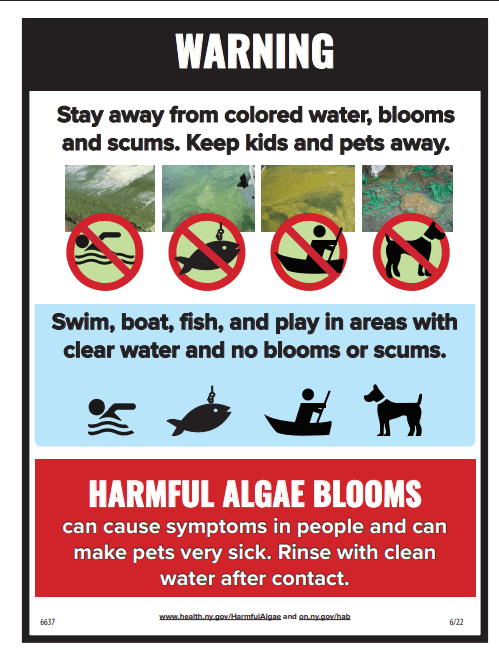
 Report Suspicious Algae If you see a strange scum on the water, stay away and keep your dog out. Then take a picture and REPORT IT to New York State Department of Environmental Conservation. They’re collecting and mapping reports of Harmful Algae Blooms. Not all algae is bad, but some causes nausea or vomiting; skin, eye or throat irritation; and allergic reactions or breathing difficulties. For more information check out the NYS Department of Health’s HAB webpage. The NY DEC gives some tips. Blue-green algae (dangerous) can look like streaks, dots, paint sheen, pea soup. Non-toxic green algae looks more like big clumps or hairy underwater plants. If you aren’t sure, stay out, take a picture and report it or email HABsInfo@dec.ny.gov |
 |
 Sustainable Sleepy Hollow
Leave a comment